
Offline map downloads can reduce repeated map-tile traffic during a trip, but they do not replace every online feature. Live traffic, transit updates, service changes and some route requests may still need data. The right strategy combines stored maps with an honest emergency data reserve.
Who is this for?
A traveler moves between neighborhoods in a city where underground stations have unreliable reception. The phone can still show a saved street map, but a delayed train platform update might require live data. Connectivity planning should separate what can be prepared offline from what must remain online.
How to compare the available choices
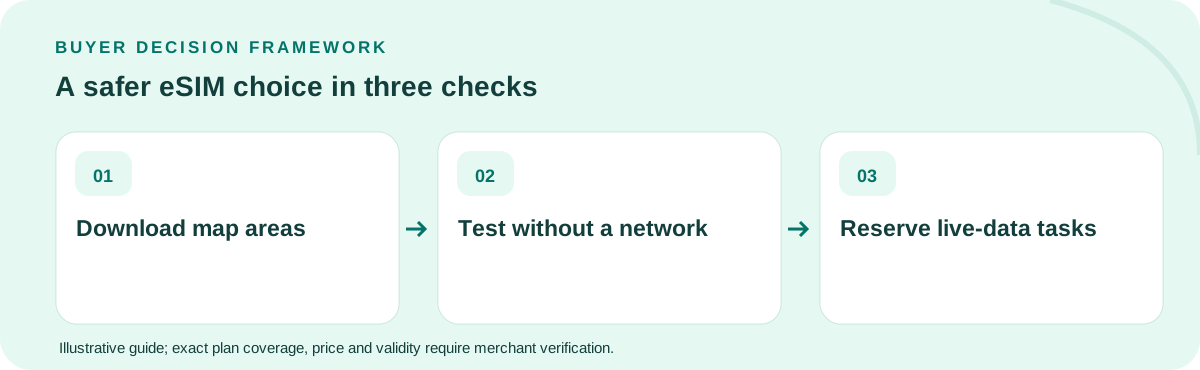
Before flying, download the precise maps supported by your preferred navigation application, verify that the area includes airports and onward routes, and open them in airplane mode as a test. Save tickets and hotel details separately; do not assume a pinned location is available without signal.
What to do before departure or purchase
Compare what you actually use: map browsing, real-time transport, rideshare, location sharing and messaging. Offline preparation can reduce one category of transfer while leaving others untouched. This is why no credible single fixed number describes all daily navigation traffic.
Worked example with explicit assumptions
Hypothetical budgeting: a traveler estimates 60 MB daily for maps and traffic over ten days, or 600 MB. If downloaded map areas reduce this category by half, the planned saving is 300 MB; the effect depends on usage and is not a benchmark for all devices or apps.
Common mistakes to avoid
The risk is treating an offline route as current information. Road closures, strikes and ticket rules can change after download. An offline map is a resilience layer, not a reason to buy a zero-data plan if the trip includes dynamic booking and transport needs.
What would change the answer?
A useful offline preparation drill is to enable airplane mode at home, open the map and retrieve the route to your hotel without a network connection. Then identify which parts fail: transit departure times, live congestion or new address searches. Those failures form a concrete mobile-data checklist, so the traveler can buy for the tasks offline maps do not replace.
Five-item decision worksheet
| Check | What to verify |
|---|---|
| Eligibility | Confirm the exact device, activation method and covered destination(s) against the retail product, not a country-average study. |
| Validity | Work backward from the situation described in this guide: A traveler moves between neighborhoods in a city where underground stations have unreliable reception. Check when the clock starts and the last active day. |
| Usage | Estimate the full-speed GB or communication capabilities this particular itinerary needs; include hotspots, essential apps and an emergency buffer. |
| Economics | Compare current final payable totals only among options that meet every requirement; treat any arithmetic example here as hypothetical. |
| Fallback | Before departure, consider this failure mode: The risk is treating an offline route as current information. Keep the seller’s support instructions available offline. |
Which option should you buy?
Use offline mapping to shrink avoidable transfers and improve resilience, then reserve mobile data for live tasks. A good travel eSIM is sized for what cannot be done offline and verified for the actual destination network.
Do offline Google Maps eliminate the need for a travel eSIM?
Not in every itinerary. Saved maps may work without data, but live traffic, transit, messaging and other services can still need internet access.
Primary technical/regulatory reference: official guidance for this topic. This source provides background, not a verification of any live TripoSIM SKU. The scenarios, prices and quantities in this guide are illustrations, not tested carrier offers. Every product's eligibility, data, voice, coverage, activation, fair use and current final price must be checked with the seller before purchase.
Ownership: This website is commercially affiliated with TripoSIM. It does not claim independent testing, neutrality or live catalog pricing. See research methodology.