
A travel eSIM advertised as 5G-capable does not guarantee that every compatible phone connects on 5G at every destination. Actual access depends on the network partner included in the SKU, the handset’s supported frequency bands, its software and current signal conditions.
Who is this for?
A traveler sees “5G supported” beside a country in a comparison table but observes LTE on arrival. That need not mean the eSIM is broken. The selected operator may use different bands, the local cell may not offer 5G where the traveler is standing, or the particular roaming agreement may not permit the expected service.
How to compare the available choices
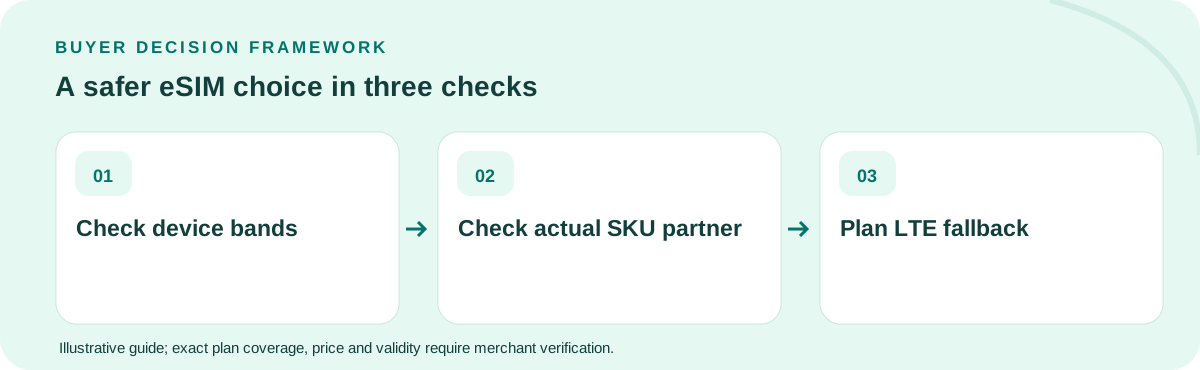
Before purchase, identify the phone’s exact model and regional version. Review the network listed for the actual plan, not merely the country summary. Consult the phone manufacturer’s technical specifications and available network maps when speed is important, while acknowledging that maps are predictions rather than measurements of every address.
What to do before departure or purchase
For a visitor who mostly needs tickets and messages, stable LTE can be entirely adequate. For high-volume uploads or tethering, full-speed allowance and network quality matter more. Compare plans on the task they must perform rather than awarding automatic preference to any 5G badge.
Worked example with explicit assumptions
Hypothetical scenario: one 5G-capable package has a 1 GB daily full-speed cap while another LTE package offers 15 GB in one shared pool. A heavy uploader could find the second more useful despite the network-generation label. The correct choice depends on terms and local performance, not the symbol.
Common mistakes to avoid
The error is equating national 5G availability with roaming access for one specific retail SKU. Another is believing that every 5G connection achieves identical speeds. Radio propagation, congestion, indoor coverage and handset bands all change the practical result.
What would change the answer?
When comparing network badges, ask three separate questions: does the phone support local bands, can this specific roaming SKU use that partner, and is 5G actually deployed where the traveler will be? None can be inferred from the other two. An accurate retailer should disclose partner networks and coverage limitations instead of promising a particular speed everywhere.
Five-item decision worksheet
| Check | What to verify |
|---|---|
| Eligibility | Confirm the exact device, activation method and covered destination(s) against the retail product, not a country-average study. |
| Validity | Work backward from the situation described in this guide: A traveler sees “5G supported” beside a country in a comparison table but observes LTE on arrival. Check when the clock starts and the last active day. |
| Usage | Estimate the full-speed GB or communication capabilities this particular itinerary needs; include hotspots, essential apps and an emergency buffer. |
| Economics | Compare current final payable totals only among options that meet every requirement; treat any arithmetic example here as hypothetical. |
| Fallback | Before departure, consider this failure mode: The error is equating national 5G availability with roaming access for one specific retail SKU. Keep the seller’s support instructions available offline. |
Which option should you buy?
Use 5G as one input after destination eligibility, handset compatibility and full-speed volume. Research tables can identify questions to ask but cannot verify current per-SKU partner access without a validated retail feed.
Does a 5G icon guarantee fast data on a travel eSIM?
No. Network technology labels describe capability, not guaranteed throughput. Location, device bands, partner roaming access and fair-use rules can all affect performance.
Primary technical/regulatory reference: official guidance for this topic. This source provides background, not a verification of any live TripoSIM SKU. The scenarios, prices and quantities in this guide are illustrations, not tested carrier offers. Every product's eligibility, data, voice, coverage, activation, fair use and current final price must be checked with the seller before purchase.
Ownership: This website is commercially affiliated with TripoSIM. It does not claim independent testing, neutrality or live catalog pricing. See research methodology.